The Discovery of America and the Founding of the United States
From an unexpected landing in the Caribbean to the birth of a modern superpower. This is the monumental
story of economic ambitions, colonial struggles, the pursuit of liberty, and the unyielding spirit that
forged the United States of America.
1. The Real Reasons Behind the Discovery of America
The discovery of the Americas was not born out of a simple desire to map the unknown, but rather out of
profound economic necessity. In the 15th century, the global economy was heavily dependent on the
lucrative spice trade. Goods such as silk, spices, and precious metals flowed from the East (India,
China, and the Spice Islands) to Europe. However, these traditional overland trade routes were arduous,
dangerous, and incredibly expensive.
The geopolitical landscape of the world changed dramatically after the Fall of Constantinople in 1453.
With the Ottoman Empire securing control over the crucial crossroads between Europe and Asia, the
existing trade routes became heavily taxed and highly restricted for European kingdoms. The soaring cost
of eastern commodities encouraged European powers—most notably Portugal and Spain—to turn their
attention to maritime exploration. They desperately needed to find alternative sea routes to Asia that
would bypass the monopolized overland corridors.
2. The "Discovery" of the New World
In 1492, an ambitious Italian explorer named Christopher Columbus proposed a daring theory: by sailing
continuously west across the vast Atlantic Ocean, one could reach the wealthy shores of India. After
facing numerous rejections, his expedition was finally sponsored by Queen Isabella I of Castile and King
Ferdinand II of Aragon, the monarchs of Spain.
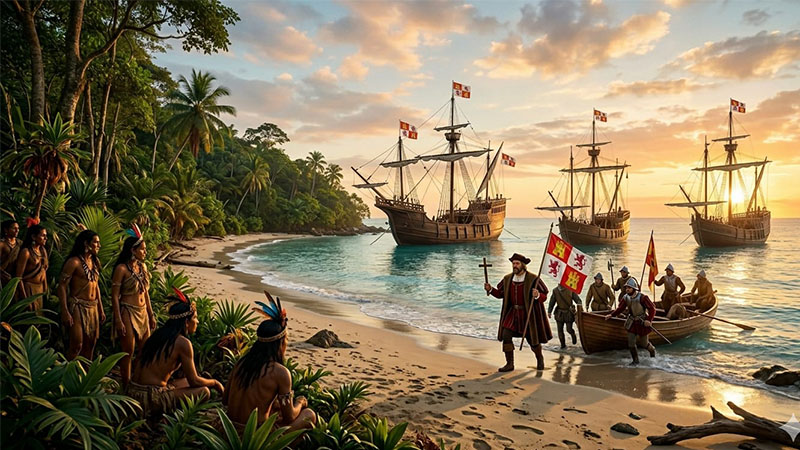
Equipped with three famous ships—the Niña, the Pinta, and the Santa
María—Columbus set sail into the great unknown. After months of perilous navigation across the
Atlantic Ocean, land was sighted. On October 12, 1492, the expedition made landfall in the vicinity of
the present-day Bahamas. Columbus, heavily relying on the geographical knowledge of his time, firmly
believed he had reached the East Indies. Consequently, he referred to the indigenous populations he
encountered as "Indians", a misnomer that would tragically persist for centuries.
It took further exploration to realize the magnitude of this discovery. It was the Italian explorer and
cartographer Amerigo Vespucci who later conducted expeditions and convincingly argued that these massive
landmasses were not part of Asia, but an entirely new continent. In recognition of his revolutionary
geographical insight, a German mapmaker later named the new land "America" in his honor.
Spain & Portugal
The earliest conquerors. Spain claimed vast territories in South America, Central America, and
the southern parts of North America, extracting immense wealth in gold and silver, while
Portugal established a massive footprint in Brazil.
The French Empire
Focusing primarily on the fur trade and diplomacy with native tribes, France established
significant colonies in the north, particularly around the Canadian regions and down the
Mississippi River towards Louisiana.
The British Crown
Starting slightly later, England focused on creating permanent agricultural settlements on the
eastern coast of North America. The Jamestown colony in Virginia, founded in 1607, marked their
first permanent and successful foothold.
3. The Thirteen Colonies and the Brewing Storm
Following the initial wave of discovery, a fiercely competitive era of colonization began. On the
eastern seaboard of North America, British settlements began to multiply. Over the course of the 17th
and 18th centuries, a total of 13 distinct British colonies were firmly established. In these regions, a
unique new society began to flourish.
The local economy thrived through the rapid development of agricultural activities, including tobacco,
cotton, and wheat farming. Bustling port cities like Boston, New York, and Philadelphia were
established, turning into massive hubs of maritime trade. Despite this growing local strength and
self-sufficiency, the colonies remained strictly tied to the British Crown politically and economically.
The Seeds of Rebellion
As the 18th century progressed, the relationship between the British administration and the American
colonies began to sour. To cover the enormous debts incurred from global conflicts (like the French and
Indian War), the British Parliament began imposing heavy and direct taxes on the American colonies. This
angered the colonists, not merely because of the financial burden, but because they had no elected
representatives in the British government to advocate for their interests.
The Stamp Act (1765): Imposed a direct tax on all printed materials in the
colonies, sparking widespread outrage and the first unified colonial response.
The Tea Act (1773): Granted a monopoly to the British East India Company,
undercutting local merchants and symbolizing British tyranny.
Trade Restrictions: The Navigation Acts forced the colonies to trade exclusively
with Britain, severely limiting their economic freedom.
The Boston Tea Party (1773): In a massive act of defiance, colonists disguised as
Native Americans dumped an entire shipment of British tea into Boston Harbor, a defining moment that
escalated the conflict beyond repair.
"No taxation without representation!" — This powerful slogan echoed across the 13 colonies, uniting
farmers, merchants, and politicians against the perceived tyranny of the British Crown.
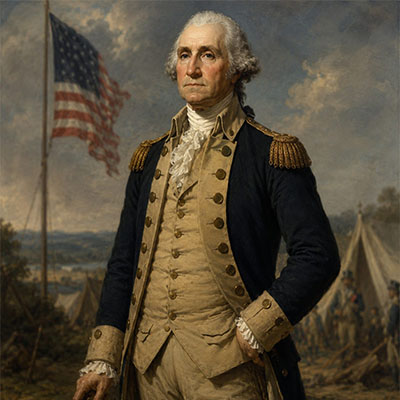
Founding Father
George Washington
Commander of the Continental Army & First President
Washington's unparalleled leadership during the grueling years of the American Revolutionary War
kept the colonial forces united against the world's most powerful military. His decision to step
down after two presidential terms established the sacred democratic tradition of the peaceful
transfer of power.
4. The American Revolutionary War and Independence
The boiling tensions eventually erupted into armed conflict. In 1775, the American Revolutionary War
officially commenced. Against the highly trained and well-equipped British military, a collective of
local militias and the newly formed Continental Army took a stand. The revolutionary movement was guided
by brilliant intellectual and military leaders, including George Washington, Thomas Jefferson, Benjamin
Franklin, and John Adams.
A monumental turning point occurred on July 4, 1776. The colonies adopted the United
States Declaration of Independence, primarily drafted by Thomas Jefferson. This extraordinary document
did not just declare separation from Britain; it laid down the philosophical foundation of modern
democracy, asserting that human rights, liberty, and popular sovereignty are inherent and unalienable.
Crucial Timeline of the Revolution
THE FOUNDING CHRONOLOGY (1773 - 1789)
[1773] : The Boston Tea Party protests unjust British taxation.
[1775] : The Revolutionary War begins at Lexington and Concord.
[1776] : The Declaration of Independence is officially adopted on July 4.
[1781] : The British surrender at Yorktown, effectively ending major combat.
[1783] : The Treaty of Paris is signed. Britain recognizes US independence.
[1787] : The US Constitution is drafted, establishing a federal system.
[1789] : George Washington is inaugurated as the 1st President of the USA.
Historical Figure
Primary Role
Key Contribution
Legacy
Christopher Columbus
Explorer
Led the 1492 expedition to the Americas
Initiated the age of global colonization
Thomas Jefferson
Founding Father
Principal author of the Declaration
3rd President, championed human rights
George Washington
Military Commander
Led the Continental Army to victory
1st President, Father of his Country
Abraham Lincoln
16th President
Led the nation during the Civil War
Abolished slavery, preserved the Union
5. Westward Expansion and The American Civil War
After officially winning its independence via the Treaty of Paris in 1783, the newly formed United
States established a federal system of government, finalized the US Constitution, and adopted a
presidential system. However, the nation was far from its final form. Driven by the philosophy of
"Manifest Destiny," the USA began a relentless campaign of westward expansion.
As new states were continually added to the Union, the country's geography and economy expanded
massively. The 19th century witnessed an explosion in industrial production, the rapid expansion of
railways connecting the coasts, accelerated urbanization, and booming trade. Tragically, this rapid
expansion came at a devastating cost to the indigenous peoples, as countless Native American communities
were forcibly removed and lost their ancestral lands.
Simultaneously, a deep moral and economic divide was tearing the nation apart. The industrialized North
and the agrarian South clashed vehemently over states' rights, economic tariffs, and most importantly,
the brutal institution of slavery. This culminated in the American Civil War (1861-1865), the bloodiest
conflict in US history. Under the steadfast leadership of President Abraham Lincoln, the Union was
ultimately preserved, and the system of slavery was permanently abolished.
6. The Rise of the United States as a Global Power
Emerging from the ashes of the Civil War, the United States rapidly industrialized. By the 20th century,
the nation experienced explosive growth in technology, military capacity, science, and global economics.
Its decisive interventions in World War I and World War II cemented its status not just as a participant
in global politics, but as the world's preeminent superpower.
In the modern era, the legacy of that small 1607 Jamestown settlement has evolved into an unparalleled
global footprint. Today, the influence of the United States dominates various crucial spheres:
Space Exploration: NASA's Apollo missions and modern planetary discoveries.
Internet Technologies: The birthplace of Silicon Valley and the modern digital
age.
Artificial Intelligence: Leading global research in machine learning and
automation.
Media & Cinema: Hollywood's massive influence on global culture and
entertainment.
Military Power: The most technologically advanced defense infrastructure in the
world.
Economic Scale: Serving as the financial center and the largest consumer market
globally.
The Dawn of the New WorldJuly 4, 1776: IndependenceThe Modern Superpower